
Named-Storm Response · June 1 – November 30
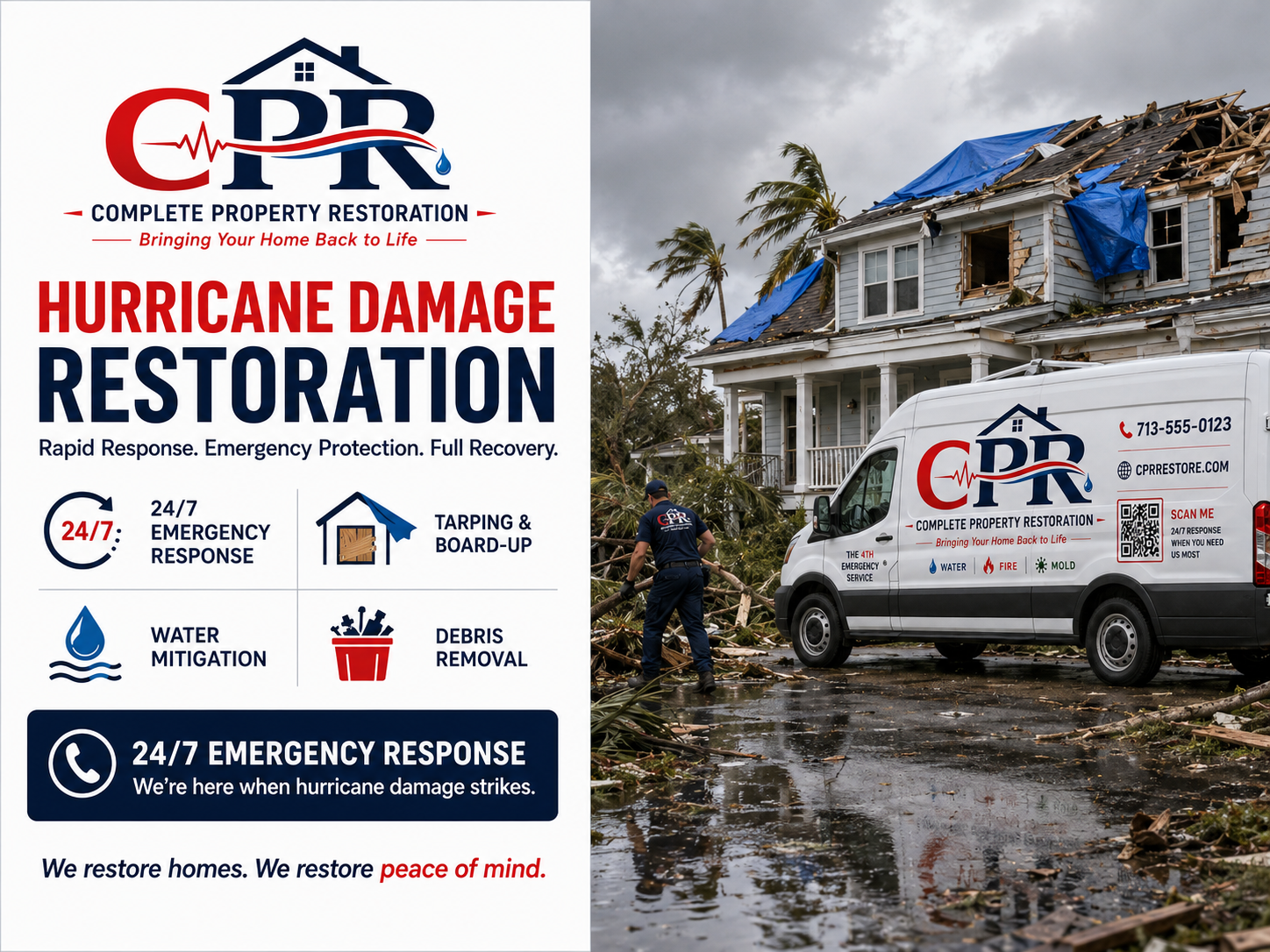
Hurricane Damage Cleanup
Bringing Your Home Back to Life.
After a named storm, three different policies may apply to one damaged house — and which one covers what depends on how the water got in. CPR documents the loss correctly, dries the structure, and rebuilds. We're based here, so we're not leaving when the season ends.
CPR — Complete Property Restoration provides hurricane damage cleanup for homes and businesses throughout the Houston metro and surrounding Texas communities — emergency tarping and board-up, floodwater extraction, structural drying, mold prevention, and full reconstruction.
Atlantic hurricane season runs June 1 through November 30, and Southeast Texas has spent decades learning what that means. Harvey rewrote the region's understanding of inland flooding. Beryl demonstrated that a storm doesn't need to be catastrophic at landfall to leave the metro without power for a week — and a house without air conditioning in a Gulf August grows mold fast, whether or not a drop of rain got inside.
The Part That Catches People
Three Policies, One Damaged House
Hurricane losses in Texas rarely fall under a single policy. Which coverage applies turns almost entirely on how the water entered — and that determination is made from documentation.
Damage from wind, and rain that entered because wind created an opening, is generally covered by your homeowners policy. Crucially, most Texas policies apply a separate named-storm or hurricane deductible to these losses — typically a percentage of dwelling coverage rather than a flat amount. On a $400,000 home, a 2 percent named-storm deductible is $8,000, and it's a different number from your regular deductible.
Water that rises from the ground and enters the structure — storm surge, creek and bayou overflow, sheet flow — is excluded from standard homeowners policies. It requires separate flood insurance through the NFIP or a private carrier. This is the single most painful surprise after a hurricane, and it's why Harvey left so many families with no dwelling coverage at all despite being fully insured.
In designated coastal counties, wind and hail coverage may be excluded from the homeowners policy and carried separately through the Texas Windstorm Insurance Association. Most of the North Houston metro sits outside the TWIA territory, but properties toward the coast and in Galveston County frequently carry it — worth confirming rather than assuming.
Why this shapes our documentation. When a house takes both wind-driven rain through a damaged roof and rising water at the slab, two carriers are looking at one building and each has reason to attribute damage to the other. We photograph water lines, record entry points, and document elevation and direction of intrusion room by room — so the split is established by evidence rather than argued over months later.
What Hurricanes Do to Houston-Area Homes
Landfall is one event. The damage arrives in waves over the following two weeks.
- Wind-driven rain through the envelope. Sustained hurricane winds push water horizontally through roof openings, ridge vents, soffits, and window and door assemblies that handle vertical rain without issue.
- Roof covering loss. Shingles, ridge caps, and sections of decking lift and peel, opening the attic to whatever falls for the rest of the storm and the days after it.
- Inland freshwater flooding. The region's defining hurricane risk. Extreme rainfall totals overwhelm bayous, creeks, and drainage, flooding homes well outside mapped flood zones — as Harvey demonstrated across the metro.
- Falling trees. Saturated soil plus sustained wind brings down mature pines and oaks onto roofs, creating structural damage and immediate water intrusion.
- Extended power outages and post-storm mold. This is the one people underestimate. Without air conditioning, indoor humidity climbs past 70 percent within a day. Homes that stayed completely dry during the storm develop widespread mold within a week of losing power.
- Sewage backup. Municipal systems surcharge under extreme rainfall and push contaminated water back into homes through the lowest fixtures — a Category 3 loss requiring removal rather than drying.
Triage, Then Restore
Our Hurricane Response Process
- 01
Emergency Tarping & Board-Up
Roof and openings secured first. In the days after a named storm this is the highest-value work we do, because it stops the loss from growing while the claim process gets moving.
- 02
Loss Documentation for Multiple Carriers
Water lines, entry points, direction of intrusion, and elevation photographed room by room — because wind and flood may both be in play and each carrier will scrutinize the boundary.
- 03
Water Extraction & Category Assessment
Floodwater is Category 3 by definition. We establish category on arrival, because it determines what gets removed versus dried and what protective protocols apply.
- 04
Controlled Demolition
Saturated drywall, insulation, carpet pad, and flooring in contaminated water come out. Flood cuts are made above the water line, and cavities are opened for drying and inspection.
- 05
Structural Drying & Humidity Control
Drying to the IICRC S500 standard, with dehumidification prioritized when grid power is unreliable. Getting humidity under control early is what prevents a second, larger mold scope.
- 06
Antimicrobial Treatment & Verification
Treatment of affected surfaces and metered verification that materials reached dry standard before anything is closed back up.
- 07
Reconstruction
Roof, envelope, insulation, drywall, flooring, cabinetry, and finishes — permitted and rebuilt by the same company that tarped the house on day one.
What Demand Surge Actually Means for You
After a landfalling hurricane, every restoration company in Southeast Texas is oversubscribed within twenty-four hours. Out-of-state crews arrive within days. Adjusters are handling hundreds of files each. Materials and labor get scarce and expensive at exactly the moment everyone needs them.
We won't pretend to be immune to that. What we will do is answer the phone with a real person, give you an honest ETA rather than a slogan, and triage active water intrusion ahead of cosmetic damage. If a closer crew would genuinely reach you faster on an emergency, we'll tell you.
And the thing that matters most six months later: we were in Spring before the storm and we'll be here after. When a hurricane rebuild has a problem in year two, you need a company that still has an address in this county.
- Emergency tarping & board-upFirst-wave loss prevention
- High-volume extractionFloodwater removal at scale
- LGR dehumidificationHumidity control during outages
- HEPA filtration & containmentCategory 3 protocols
- Thermal imaging & moisture mappingWind vs. flood intrusion documentation
- Full reconstructionRoof, envelope, and interior rebuild
Why Homeowners Call CPR
Built on Certifications, Not Commercials.
CPR was founded by Tim and Dana, who bring more than ten years in Texas real estate and property operations to every job — the judgment of an owner, not the script of a franchise.
Service Areas
CPR is dispatched from our home base in Spring, Texas and responds throughout the Houston metro and surrounding communities. Response times vary by distance — call and we'll give you a straight answer for your address.
Communities We Serve
Hurricane Damage FAQs
Straight answers to what Houston-area homeowners ask us most.
Does my homeowners insurance cover hurricane flooding?
Not the flooding, no — and this is the most consequential thing to understand before a storm rather than after one. Standard homeowners policies exclude water that rises from the ground, which includes storm surge, bayou and creek overflow, and sheet flow across saturated ground. That requires separate flood insurance through the NFIP or a private carrier. Wind damage and rain that entered through a wind-created opening are generally covered. Many Harvey-affected families were fully insured and still had no dwelling coverage, because the water came from below rather than above.
What is a named-storm deductible?
A separate, usually higher deductible that applies specifically to losses from a named tropical storm or hurricane. It's typically a percentage of your dwelling coverage rather than a flat dollar amount — commonly one to five percent in Texas. On a $400,000 home, two percent is $8,000, which is a very different number from the $2,500 you might pay on a kitchen fire. Check your declarations page now rather than during a claim.
Should I wait for my adjuster before starting cleanup?
No — and waiting can hurt you. Most policies include a duty to protect the property from further damage, so emergency tarping, board-up, and water extraction should begin immediately and those costs are typically reimbursable. What you shouldn't do is start permanent repairs or throw away damaged materials before the loss is documented. Photograph everything extensively, keep damaged materials where practical, save all receipts, and let mitigation proceed while the claim works through the queue.
My house stayed dry but we lost power for a week. Do I have a problem?
Possibly, yes, and this is genuinely underestimated in this region. Without air conditioning, indoor relative humidity in a Gulf Coast summer climbs past 70 percent within about a day and stays there. Under those conditions mold can establish on drywall paper, wood, and fabrics throughout the house without any water intrusion at all. If you came home to a musty smell after an extended outage, it's worth an inspection even though nothing flooded.
Is floodwater in my house dangerous?
Treat it as contaminated. Hurricane floodwater carries sewage overflow, chemicals, fuel, and debris, and under the IICRC standard it's Category 3 regardless of how it looks. Practically, that means porous materials it touched — drywall, insulation, carpet, pad — get removed and disposed of rather than dried, and crews work in protective equipment. Don't wade through it unnecessarily, and keep children and pets out entirely.
How do I know whether wind or flood caused my damage?
Often both did, which is exactly why documentation matters so much. The general principle is that water entering from above through a wind-created opening falls to the homeowners policy, and water rising from below falls to flood coverage. In practice the boundary gets contested, since each carrier has an incentive to attribute damage to the other. We photograph water lines, entry points, and intrusion direction room by room specifically so that determination rests on evidence.
How long will it take to get to my house after a hurricane?
Honestly, longer than any of us would like, and we won't pretend otherwise. After a landfalling storm every restoration company in the region is oversubscribed within a day. What we commit to is a real person answering, a candid ETA for your specific address rather than a scripted promise, and triage that puts active water intrusion ahead of cosmetic damage. If someone closer could genuinely reach you faster in an emergency, we'll say so.
How can I prepare before the next storm?
A few things pay for themselves. Photograph or video every room and the exterior now, while everything is intact, and store it somewhere off-site — pre-loss condition is the hardest thing to prove after the fact. Read your declarations page and confirm your named-storm deductible and whether you carry flood coverage; NFIP policies generally have a thirty-day waiting period, so buying during a watch is too late. Keep copies of your policy and carrier contact information somewhere you can reach without power.