
Emergency Tarping · Board-Up · Water Extraction
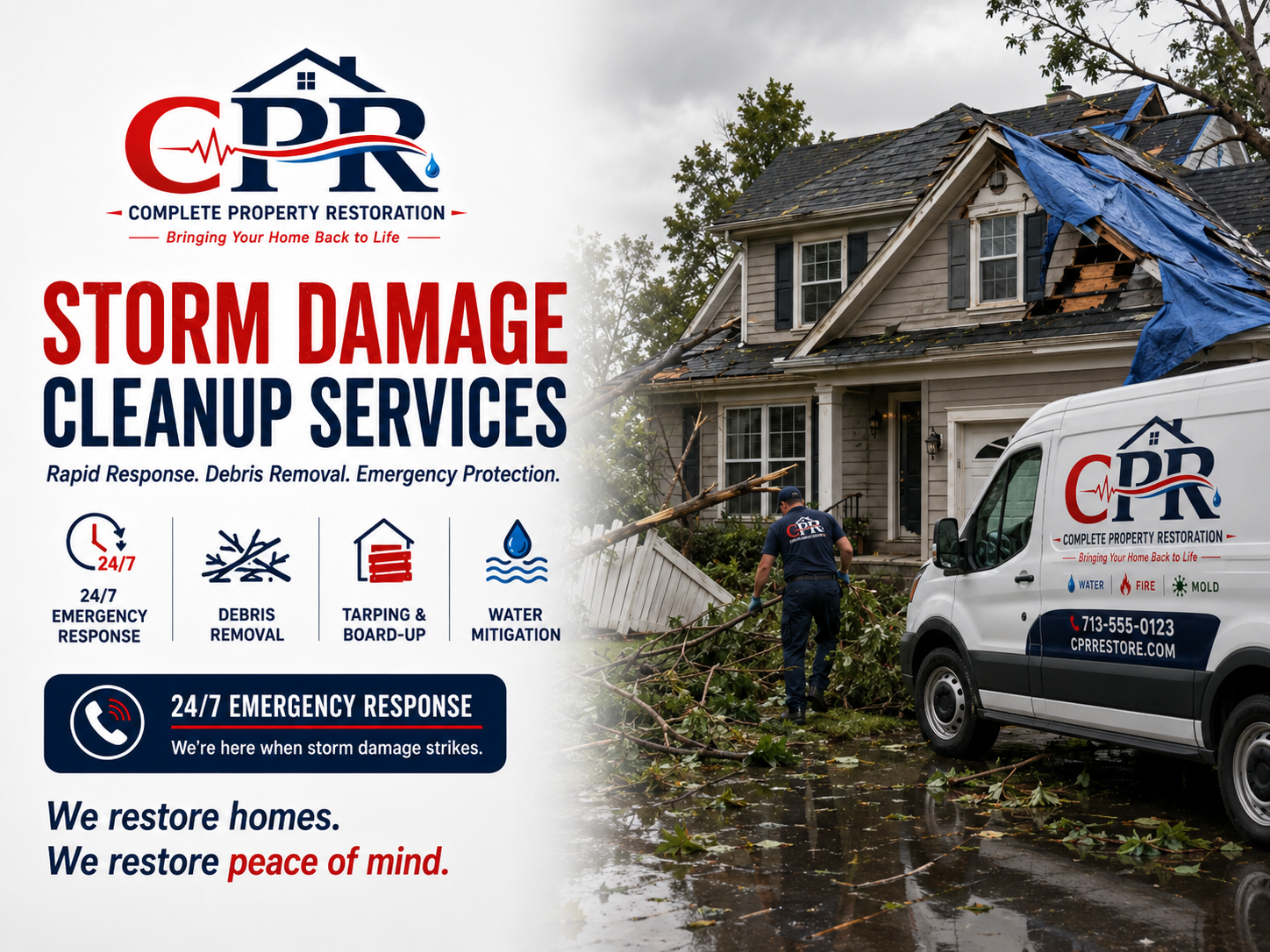
Storm Damage Cleanup
Bringing Your Home Back to Life.
Hail, straight-line wind, tornado, hard freeze. Severe weather hits the Houston area year-round, and the interior damage usually starts hours after the storm passes. We tarp, board, extract, and rebuild — and we're still here next season.
CPR — Complete Property Restoration provides 24/7 storm damage response for homes and businesses throughout the Houston metro and surrounding Texas communities — emergency roof tarping and board-up, water extraction, debris and tree removal, structural drying, and full reconstruction.
Storm damage almost never stops at the roof. A hail-punctured shingle or a wind-lifted ridge cap lets water into the attic, where it saturates insulation, soaks ceiling drywall, and runs down inside wall cavities before anything shows on your ceiling. By the time a stain appears, you have a water loss on top of a roof loss — and in Gulf humidity, mold is on a 24-to-48-hour clock from there.
What Severe Weather Does Here
Hurricanes get the attention, but most of the storm work in North Houston comes from weather that never gets a name.
- Hail. Bruises and fractures shingle mats without obviously destroying them. The roof looks intact from the ground while its useful life has been cut short and its water resistance compromised. Damage is often invisible until leaks begin months later, which is why documented inspection after a hail event matters.
- Straight-line winds. Downbursts and derecho-type events routinely produce hurricane-force gusts without a hurricane. They lift shingles, peel ridge caps, tear off siding and soffit, and bring down fences and trees.
- Tornadoes. Southeast Texas produces tornadoes, most often embedded in squall lines ahead of a cold front. Damage runs from partial roof loss to structural failure along a narrow path.
- Hard freezes. The regional weak point. Attic-run plumbing in two-story homes ruptures during Arctic outbreaks, and a single burst line can saturate two floors before anyone wakes up. Winter Storm Uri demonstrated the scale.
- Falling trees and limbs. Saturated soil plus wind brings down mature pines and oaks. Impact damage to roof structure creates immediate water intrusion and often structural compromise.
- Lightning. Direct strikes cause structure fires and surge damage to electrical systems, HVAC, and appliances — frequently in homes with no visible exterior damage at all.
Read This Before You Sign Anything
Storm Chasers Follow the Weather. We Live Here.
After every significant hail or wind event, out-of-state crews arrive in the Houston metro within days. Some are legitimate. Many are not, and homeowners who just had a bad night are the target.
Unsolicited crews going door to door offering a free inspection, claiming they noticed damage from the street, or saying they're already working on your neighbor's house. Legitimate local contractors are usually too busy after a storm to canvass neighborhoods.
An offer to waive, absorb, or rebate your insurance deductible. In Texas it is illegal for a contractor to advertise or promise to pay a homeowner's insurance deductible, and a contractor willing to break that law is telling you something about how they'll handle the rest of your job.
Pressure to sign immediately, large deposits up front, or a document that assigns your insurance benefits to the contractor. Read anything before you sign it, and be especially careful with paperwork presented as a formality that lets them "start the inspection."
The practical test is simple: ask where their office is and how long they've been at that address. Ask who you call in two years if the roof leaks. A company that was in Spring last year and will be here next year has to answer for its work. One that follows storms across state lines does not.
Same Day, Then Properly
Our Storm Response Process
- 01
Emergency Tarping & Board-Up
The roof gets covered and openings get secured before anything else. Every hour an opening stays exposed adds interior damage, and most policies expect prompt action to prevent further loss.
- 02
Safety & Debris Assessment
We evaluate structural stability, downed limbs, and electrical hazards before crews or family go back inside. Impact damage from a fallen tree is a structural question, not just a roofing one.
- 03
Water Extraction & Attic Inspection
Standing water comes out and we get into the attic, because that's where storm-driven water goes first. Saturated insulation is removed rather than dried — it doesn't recover.
- 04
Documentation for the Claim
Photographs of exterior damage, hail strike patterns, interior water paths, and moisture readings. Wind and hail claims turn on evidence of the storm's effect, so this step decides how the claim goes.
- 05
Structural Drying
Air movers and LGR dehumidifiers to the IICRC S500 standard, with readings logged until materials reach dry standard. This is the step that prevents a storm claim from becoming a mold claim.
- 06
Debris & Tree Removal
Removal and disposal of storm debris, damaged materials, and downed limbs, coordinated with the structural repair schedule.
- 07
Reconstruction
Roof decking and covering, siding, soffit, fascia, windows, insulation, drywall, and interior finishes — one crew, permitted through the proper jurisdiction.
How Wind and Hail Claims Actually Work
Storm claims have their own rules, and two of them catch Texas homeowners off guard.
Your wind and hail deductible is probably a percentage. Many Texas policies apply a separate percentage-based deductible to wind and hail losses rather than the flat dollar amount you'd pay for a kitchen fire. On a $400,000 dwelling, a 2 percent wind-hail deductible is $8,000. Check your declarations page before you assume you know your out-of-pocket.
Roofs are often settled at actual cash value. A growing number of Texas policies pay depreciated value on roof coverings rather than replacement cost, particularly on older roofs. The difference on a full roof replacement can run into thousands. We'll help you read what your policy says and scope accordingly.
We bill your carrier directly and handle the adjuster conversation.
- Emergency roof tarpingSame-day weather-tight coverage
- Board-up & opening securityWindows, doors, breached walls
- Truck-mount & portable extractionBulk water removal
- Thermal imagingTracing water paths from roof to wall cavity
- LGR dehumidifiers & air moversS500 structural drying
- Documented hail & wind inspectionPhotographic evidence for the claim
Why Homeowners Call CPR
Built on Certifications, Not Commercials.
CPR was founded by Tim and Dana, who bring more than ten years in Texas real estate and property operations to every job — the judgment of an owner, not the script of a franchise.
Service Areas
CPR is dispatched from our home base in Spring, Texas and responds throughout the Houston metro and surrounding communities. Response times vary by distance — call and we'll give you a straight answer for your address.
Communities We Serve
Storm Damage FAQs
Straight answers to what Houston-area homeowners ask us most.
My roof looks fine after the hail. Do I need it inspected?
Probably, yes. Hail frequently bruises and fractures shingle mats without breaking through, so a roof can look sound from the ground while its water resistance and remaining life have been meaningfully reduced. Leaks often show up months later, at which point connecting them to the storm is harder and your claim window may have closed. A documented inspection after a significant hail event costs you nothing and creates a dated record.
What should I do first after storm damage?
Safety before property. Stay away from downed power lines and don't enter a structure with visible sagging or a tree through the roof. If it's safe, photograph everything from multiple angles before any cleanup, including the exterior, the attic, and every interior water stain. Then make temporary repairs to prevent further damage — tarping, covering broken windows — and keep the receipts, since those costs are typically reimbursable. Call your carrier and a restoration company the same day.
Why is my deductible so much higher than I expected?
Because many Texas policies apply a separate percentage-based deductible to wind and hail claims. Instead of a flat amount, you may owe a percentage of your dwelling coverage — commonly one to five percent. On a $400,000 home, two percent is $8,000. It's on your declarations page under wind and hail or windstorm, and it's worth knowing before you file rather than after.
How long do I have to file a storm claim in Texas?
Your policy sets the deadline, and most require prompt notice, with an outer limit that's commonly two years from the date of loss under Texas law. Practically, waiting hurts you regardless of the deadline: carriers scrutinize delayed reports, damage keeps compounding, and proving that a leak came from a specific storm eighteen months ago is difficult. Report it as soon as you know.
Someone knocked on my door offering a free roof inspection. Should I use them?
Be careful. Out-of-state crews follow storms into the Houston metro every season. Some are legitimate; many disappear once payment clears and their workmanship warranty is worthless. Verify a local physical address, check how long they've been at it, confirm insurance, and never work with anyone who offers to cover your deductible — that's illegal in Texas. Never sign anything you haven't read, especially documents assigning your insurance benefits.
Is water damage from a storm-damaged roof covered?
Generally yes, when wind or hail created the opening. Interior water damage resulting from a covered wind or hail event is typically covered as part of that loss. Where carriers push back is on roofs that were already failing, where they may argue the intrusion resulted from wear rather than the storm. That's another reason documenting the storm damage promptly and specifically matters so much.
How fast can you get here after a major storm?
Honestly, it depends on how widespread the event was. During a metro-wide hail or wind event, every restoration company in the area is triaging hundreds of calls at once and no one can promise a fixed window. What we can promise is that a real person answers, you get a candid ETA for your address rather than a slogan, and we prioritize active water intrusion over cosmetic damage. If a closer crew would genuinely reach you faster on an emergency, we'll say so.
Do you handle tree removal and debris?
Yes, as part of the restoration scope — removing the tree or limb, clearing debris, and repairing the structural and water damage the impact caused. We coordinate it with the repair schedule so the roof isn't opened up again after it's been closed. Standalone tree service with no property damage isn't what we do.